
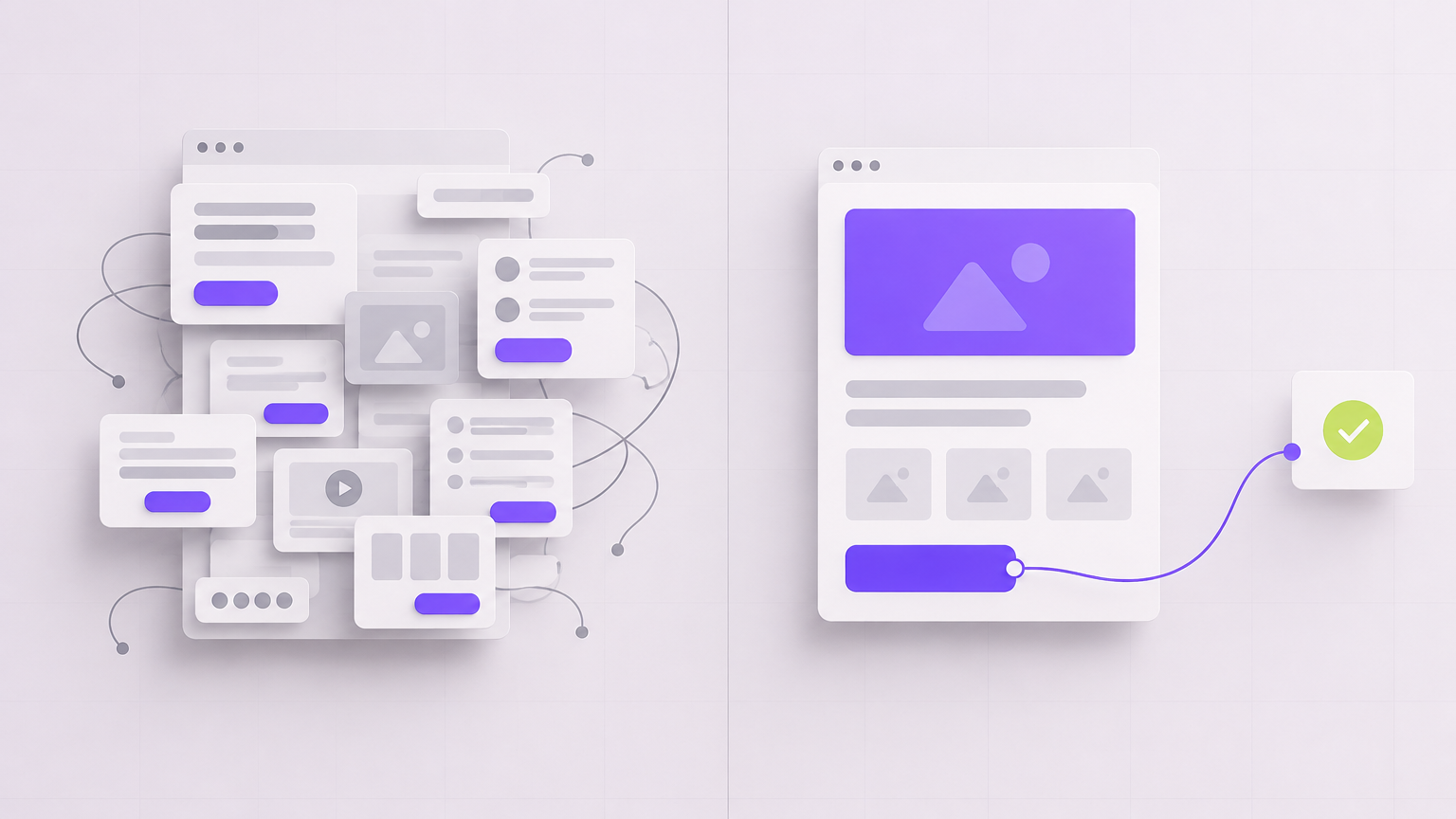
Your analytics dashboard says people are visiting. Your inbox says something else. If your website is not generating leads, the problem is rarely solved by changing a button color or buying more traffic. The real issue is usually a break in the journey between attention and trust and action.
Think about a prospect who discovers your business after searching for a service. They have three immediate questions: Am I in the right place? Can this company solve my problem? What should I do next? If your website makes any of those answers difficult, visitors leave or postpone the decision.
THE QUICK ANSWER
A website often fails to generate leads because its message is unclear, its traffic is poorly matched to its offer, its proof is weak, or its next step creates friction. Fix the biggest gap first, then measure qualified inquiries—not clicks alone.
1. Your hero section explains your company, not the customer's problem
“Digital solutions for the future” sounds ambitious but tells a buyer almost nothing. A stronger opening identifies the audience, outcome and offer: “Webflow websites for growing B2B teams—built to explain complex services and convert qualified visits into sales conversations.”
Use this simple headline formula: Who you serve + what you deliver + the outcome they care about. Then add one supporting sentence showing how you approach the work and one primary call to action (CTA). Give readers a clear path to detailed service pages if they are not ready to talk.
TRY THIS / THE FIVE-SECOND TEST
Show your homepage to someone unfamiliar with the business for five seconds. Ask what the company sells and whom it serves. If they cannot answer, rewrite your first screen before investing in more traffic.
2. Your traffic is not looking for the service you sell
High visitor numbers can hide a mismatch. An article explaining what UX design is may attract students; a landing page titled “UX audit for SaaS onboarding” may attract product teams with an active problem. Both can be useful, but they should not be judged by the same conversion expectation.
In Google Search Console, compare queries and landing pages. In analytics, compare organic traffic, referrals and campaigns by engaged sessions and relevant key events. Look for search intent: research, evaluation, comparison or purchase. Build a logical next step for each type of visitor instead of giving every page the same “Book a call” message.
3. Visitors cannot find a compelling reason to trust you
Trust is not created by badges alone. Buyers want evidence that resembles their own challenge. A case study should show the starting problem, constraints, decisions, deliverables and observable outcome. If numerical results are unavailable, explain what changed without inventing performance gains.
Replace vague claims like “industry-leading experts” with concrete proof: a real project preview, the team’s role, the launch scope and a client-approved testimonial. Put proof near major decision points—not only on a separate portfolio page.
4. Your next step asks for too much commitment
A prospect evaluating three providers may not want a 45-minute call yet. Offer a lower-friction path: see a relevant case study, request a scoped estimate or submit a short project brief. Keep forms focused on details that actually help qualify a project.
A service CTA might say “Discuss your website goals”. An article CTA could say “Get a review of your conversion bottlenecks”. These are distinct next steps for distinct stages of interest.
5. Mobile usability and page experience create hidden friction
Check your page on a real phone. Is the headline readable? Can someone dismiss cookie controls? Are tap targets large enough? Does a pricing comparison require awkward horizontal scrolling? Are fonts and images loading predictably?
Performance deserves attention too. Google's Core Web Vitals assess loading, responsiveness and visual stability; they are useful diagnostic signals, not a magic ranking or conversion formula. Start by compressing oversized imagery, reducing unnecessary scripts and testing the actual pages where prospects arrive.

6. Your service pages describe features instead of outcomes
“Custom Webflow development, CMS integration and SEO setup” names tasks. A useful service page connects tasks to business needs: easier publishing for the marketing team, cleaner navigation for prospects and a website structure ready for organic growth. Explain your process, deliverables, exclusions, timeline dependencies and how success will be evaluated.
Link each insight to its most relevant service page. For example, this article naturally connects to a website audit, conversion-focused design and the website redesign checklist.
7. You are measuring form submissions, not qualified opportunities
Suppose 1,000 visitors produce 20 form submissions. That's a 2% submission rate, but not necessarily 20 sales leads. If 16 are spam or unrelated inquiries, your true business result is four qualified inquiries. Define your qualified lead criteria before claiming a lift.
Track a small funnel: relevant landing-page visits → CTA clicks → form starts → completed inquiries → qualified leads → opportunities. Use analytics alongside CRM feedback, and follow applicable consent and privacy requirements.
MEASURE THE RIGHT OUTCOME
- 1,000
website visitors - 20
form submissions - 4
qualified inquiries
Illustrative example from this article. Of 20 submissions, 16 are spam or unrelated inquiries. This is not a conversion benchmark.
A practical 14-day lead-generation diagnosis
- 1–2
Review Search Console queries and top landing pages
Is visitor intent relevant? - 3–4
Interview three recent customers or prospects
Which questions remain unanswered? - 5–6
Test homepage and key service page on mobile
Where is the friction? - 7–9
Rewrite the hero, proof and primary CTA
Is the offer more understandable? - 10–12
Fix form usability and event tracking
Can you measure the journey? - 13–14
Compare baseline metrics and plan a longer test
Which hypothesis deserves priority?
Do not make all seven changes and assume you know which one worked. Prioritize based on evidence; test meaningful improvements where traffic volume allows.
Frequently asked questions
Why is my website getting traffic but no leads?
Usually because the wrong visitors are arriving, your offer is not clear, trust is insufficient, or the contact process is too difficult. Segment traffic by query and landing page before changing the design.
What is a good website conversion rate?
There is no universal benchmark that fits every industry or lead definition. Compare your qualified-lead rate against your own baseline, channel mix and sales outcomes rather than chasing one generic percentage.
Should I redesign my entire site to increase leads?
Not automatically. Fix high-impact messaging, navigation, proof or form issues first. A full redesign is more appropriate when underlying structure and positioning prevent incremental improvement.
Turn your website into a clearer sales conversation
A website should make the right visitor feel understood and confident about the next step. At Weboolf, we connect strategy, design, development, SEO and measurement instead of treating them as isolated projects. Explore Weboolf and start with the bottleneck that matters most.

November 10, 2026
FURTHER READING